
Regional Advocacy Workshop (Online)
[ 16 Dec, 2021 ]
In preparation for World Water Forum and The UN Conference for the Water Decade (2023), a Regional Advocacy Workshop (online) was organized by Freshwater Action Network South Asia (FANSA) in collaboration with Butterfly Effect on 16th December 2021.
The workshop was basically aims to voice the views of the CSO’s and NGO’s active in water-related issues at a higher level, mainly at the two upcoming global forums; The Head of States summit of the 9th World Water Forum and the 2023 UN Water Decade conference to be held in New York in March 2023, to influence decision-makers for positive, ambitious and concrete systemic changes on how water and sanitation are managed, while contributing to the SDG6 implementation.
This workshop was part of a larger influencing process led by the Butterfly Effect coalition and aims to enable NGOs and CSOs to speak with one voice and influence decision-makers for positive and ambitious changes in favor of better water resources management and sanitation and concrete implementation of the UN 2030 Agenda.
The workshop was formally initiated by Ms. Snehalatha Mekala, the Regional Coordinator of FANSA with her welcome remarks. She delivered her remarks highlighting briefly about FANSA and also talked about engagement of FANSA is WASH advocacy sector. She concluded her remarks with the detail about the program agenda for the workshop.
The Regional Convenor of FANSA, Ms. Lajana Manandhar delivered her remarks highlighting the purpose and objectives of the workshop. On her remarks she stressed the need to ensure people’s voice and right to access better water and sanitation facilities. She said that it needs to be always respected and addressed at policy level, incorporated in institutional set ups and implemented on ground in every changed scenario. She added, this is also the time for a strong advocacy to achieve SDG goals, for the sustenance of the water resource, for investment in innovations in technology, operation modality, and policy decisions. She further added, sensitive and strong engagement from the private sector, donors and other partners are also important.
Highlighting the purpose of the workshop she said, the workshop is intended to discuss, collect opinion, concerns, suggestions and advices on different themes and aspects of water and sanitation and use the generated knowledge for advocacy at higher level, mainly at the two upcoming global forums; The Head of States summit of the 9th World Water Forum and the 2023 UN Water Decade conference to be held in New York in March 2023.
Concluding her remarks she said, the experiences and voices of the civil society organizations matter as CSOs are the ones who are always in direct contact with the communities and exposed to gains and pains of the communities with or without water. Encouraging the participants for their active participation she said, your contributions will enrich the discussion and add in formulating powerful advocacy messages and demands to be submitted at the upcoming two key global conferences.
Presentation on the “Outcome of the online Consultation on CSOs priorities and demands with respect to WASH” Sharing the results of the “Online Consultation on CSOs priorities and demands regarding WASH”, the Project coordinator of Solidarity Water Europe, International Secretariat for Water Ms. Anne Catherine Mercury made a presentation that highlighted the process of survey, key questions and the outcome.
The Consultation was carried out during mid-July to mid-August 2021 and had contributions from 44 NGOs/CSOs – 18 from Africa, 12 from Europe, 5 each from Asia and Central/South America and 4 from North America.
The BE process of consultation comprised of 8 questions to gather some preliminary data and feed the BE’s advocacy process. The questions were as follows:
1. What are the main water-related problems you face in your country or in the places where you work as an organization?2. In your opinion, what are the main causes of this/these problem(s)?
3. What are the most direct consequences?
4. Based on your selection and analysis, what concrete policy, administrative or legislative changes would be needed to improve this situation?
5. If you could talk to decision-makers in your country or region about the water-related problems and solutions you have identified, what would you say in 1 minute?
6. What can you do as a CSO/NGO to address these issues?
7. What would you need as an NGO/CSO to solve this issue(s)?
8. At the global level, are there any key decisions that states, and the international community should collectively make to accelerate the implementation of the internationally agreed upon 2030 Agenda water goals?
In summary, the consultation highlighted six areas of change on which NGOs and CSOs should challenge the policy makers:
1. Demonstrate strong political will in the area of water and sanitation
2. Strengthen legal and institutional frameworks and water governance
3. Make concrete financial commitments for water and sanitation
4. Strengthen civil society and ensure citizen participation
5. Delivering on commitments and establishing accountability
6. Improving international cooperation and the multilateral framework for water and sanitation.
Followed by the presentation of Ms. Mercury was the open floor for the queries where the significant numbers of participants shared their opinions and put forward their questions.
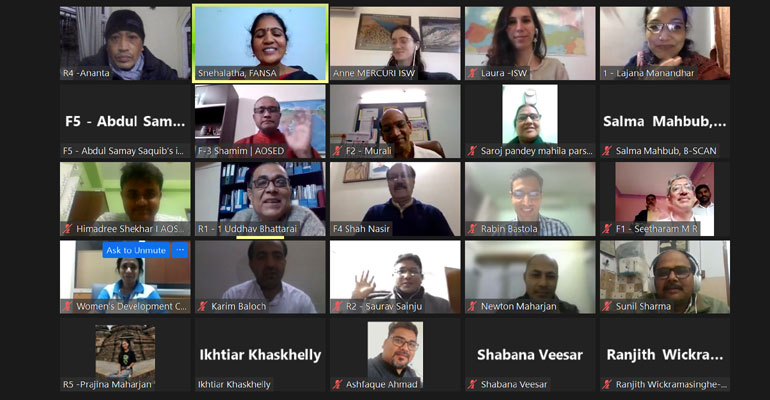
Total of 79 representatives from different organizations active in water related issues from South Asian countries which includes Afghanistan, Bangladesh, Bhutan, India, Maldives, Nepal, Pakistan, Srilanka and also Thailand participated in the virtual workshop.
The next session after the open floor was the breakout sessions. There were total of 5 thematic issues with different facilitators to lead the sessions. The participants were also divided into 5 breakout rooms for discussions which is followed by the plenary sessions where the facilitators presented the findings.
Theme 1: Political will
Facilitated by: Dr. Seetharam, CSO representative, SWA Steering Committee Member
Brief on Group work framework:
The objective of this group work was to generate some important messages for advocacy at Global and Regional level. The dimension of “Political will” as a theme is the prerequisite for achieving “water for all and everywhere” and ensuring implementation of “HRWS” and LNOB.
There are two main questions to be discussed in group– How is political will with regards to WASH? And what is we want with political leaders to change?
-What can be done at National level? -What can be done at international cooperation level?
Outcome from the Group 1:
National level action points:
1. Visibility and implementation:
There is difference between the projected visibility and implementation on the ground. The visibility mainly covers manifestos, slogans but translation of the manifesto with respect to program and budget allocations are missing.
2. Vertical and horizontal integration:
This is about responsibility, accountability, coordination and learning sharing among the tiers of the government as well as the sectoral departments. Looking at both dimensions is important.
3. Accountability measures needs strengthened:
What is said and what is done needs to be tallied. Social audit could be one of the prominent tools to make this effective.
4. Capacity building of Political leaders:
Capacity of the leaders to see Inter-connectedness of WASH to several gamut of developmental sectors could be developed. WASH is integral to health, education, environment, livelihoods, infrastructure and many more could be well established and educated.
5. Role of research organizations/academia for collaborations and bringing functionalities at grassroots level.
6. Adequate focus for the vulnerable groups
International level action points:
1. Use of platforms – SACOSAN, SWA and similar other ones
2. Interconnectedness of issues with WASH
3. Agenda setting together with vulnerable groups by donors / (donors also) need to learn
Theme 2: Institutional Framework
Facilitated by: Mr. Murali Ramisetty, RSC member, FANSA
Outcome from the Group 2:
1. Integration of IWRM and SWRM in legal framework and institutional mandate
Integrated water resource management and sustainable natural resource management etc. are not adequately integrated into the legal framework of the countries and the institutional mandate of the countries. This is the major kind of issue. It is important to formulate specific messages to present in the high-level platform.
2. Language issues in application, enforcement and translation of the laws and mandate
There is radical progress in language while reviewing laws of the country related to water or the institutional mandate. There are huge number of gaps and challenges when it comes to application, enforcement and translation of the spirit of the laws and institutional mandate into actual practice.
3. Inadequate resources, capacities and powers for river-based organizations
There are river-based organization responsible for sustainable management of river water as well as responsible for monitoring and overseeing the water related organization at different levels in all countries. But those organizations do not have adequate resources, capacities and powers to check their functioning.
4. Need of clearly defined roles and responsibilities of agencies working in water issues in all level
Multiple agencies, ministries, institutions dealing with water issues at the local level, district level, state level and the national level. Roles and responsibilities of such authorities are not clearly defined. There is the huge lack of accountability observed.
5. Capacity enhancement of community level stakeholders and provide adequate resources
Lack of capacity of the community level stakeholders’ organizations so that the infrastructure constructed at the local level is not being well maintained by the users’ organizations. Creating knowledge, capacity and provide adequate resources to community level stakeholders is also very important. Thus, these must be reflected in the legal and institutional mandate of the water governance within the country.
Theme 3: Financial commitments
Facilitated by: Mr. Shamim Arfeen Executive Director, AOSED
There are two main questions to be discussed in group:
1. What are the national level and international commitments for the financial contribution for the achieving SDG-6?
2. Local and national level policies, implementing strategies, Public Private Partnership (PPP), contribution from private including role and commitments to achieve goal of SDG-6
Outcome from the Group 3:
1. Political commitment and inclusion of CSOs in monitoring system
All government should include the NGOs and CBOs in the monitoring system. Political commitment is very important to resolve the financial issues nationally and internationally. Government should include the NGOs and CSOs in the SDG tracking process. The NGOs and SOs should also pursue the government for the same.
2. Special financial plan for water sector in all countries
Country should have special financial plan for all sector including water to meet the SDGs commitments. Such financial plan related to water sector should also be focused for marginalized groups and slums as they are the most vulnerable groups in terms of impact due to the climate change. As migration rate in the urban area is escalating creating a big challenge globally, special financial plan to address such issues has become essential in all countries. National government should provide incentives to the financial institutions and private sector for addressing WASH. It is important to create an enabling environment for the private sectors and local entrepreneurs to provide WASH services. Micro finance institutions need to increase WASH loan.
Countries should have specific financial planning for WASH. Specific financial planning for access of drinking water for the rural marginalized people including for the urban poor people need to planned and implemented.
Government should committed to provide funding through different ways who can afford financing taking from bank that can be subsidized. Water Sanitation loan can be subsidized by the government for the poor people.
There should be specific financial planning in case of building infrastructures in water bodies for conducting SIA/EIA.
3. Advocacy for WASH governance
Discrimination in the allocation of government fund in urban, rural and peri-urban area in the countries are observed and discussed. There is also some kind of gaps and issues in the WASH fund in the global level as well. Thus, WASH governance in another important issue to discuss.
Financial planning is important and should advocate to give the utilization of WASH accounts. It is important to increase the country wise WASH budget to achieve the SDG-6.
Government should coordinate with local, national and international agencies for private partnership on financing WASH including the subsidized rate need to be advocated.
4. Special funding to address multi-dimensional climate change impact
Considering the impact of multi-dimensional climate change impact in the vulnerable countries like Bangladesh, India and many more, special funding needs to be focused to address the issues, specifically the issues related to water and agriculture in the vulnerable countries.
The world community need to recognize the climate change effect in the countries that affected the WASH and undertake adaptation and mitigation measures. Multi-dimensional effect of climate change should be considered.
Funding for research for the appropriate technologies which can reduce effect of climate change. Climate change is global issue but the effect on poor and marginalized people is more so the national and international community should plan for especial kind of funding.
5. Capacity building
Capacity building of the local government should be the priority of the national government as they are the front-line service providers for the communities.
The national and international agencies should strengthen institutional capacity building and sustainability of service delivery system to strengthening community and institutional capacity to achieve SDG-6.
6. Water issues in National adaptation plan
Countries are developing the National adaptation plan but the issues related to water are not included in the plan. Inclusion of water related issues in the National adaptation plan is essential. CSOs need to advocate for these initiatives.
7. Quality drinking water is the challenge
Water quality is another crucial issue to be addressed by the stakeholders. The national government and other stakeholders including CSOs and donor need to support technically to ensure the water quality and should monitor the process.
There are lot of challenges on water quality. Surface water bodies need to be preserved and conserved. Rainwater harvesting technologies must be promoted to fulfill the demand during dry season by government, national and international development partners.
WASH and Hygiene is key factor, need more programs in community by local government in coordination with the donor agencies. Due to COVID-19, it had create lot of challenges to achieve goal. The country had to use its huge amount of budget on COVID-19 reducing other sectors including WASH. Funding for the poor countries on WASH is important after COVID-19 to achieve SDG.
Theme 4: Civil society engagement
Facilitated by: Mr. Shah Nasir, RSC member, FANSA
There are two main questions to be discussed in group
– What country policy demand would you address to policy makers at the National level?
– What country policy demand would you address to policy makers at the international level?
Outcome from the Group 4:
1. Capacity building of CSOs and showcasing of CSOs’ work and share at international level
The international policy makers and politician have their own theory about CSOs participation and engagements. They should know about the CSOs work. There should be a new interpretation about CSOs engagement and participation for global policy maker and politicians.
2. Cross-continental learning and sharing experiences
Inter-continental knowledge sharing and exchange learning is the must to know about each other’s good practices and approaches adopted.
3. Owning of local, national, regional and international advocacy policies
Some of the organization and networks have their policies but are adopted from the international partners. The CSOs should bear their own in local, national, regional and international advocacy policy.
4. Engagement of CSOs in policy making is the must
Due to the lack of involvement of CSOs in the policy making, the policies do not really address the marginalized people. It has become essential to convince the international policy makers and politicians for the global universal design of the WASH infrastructure to properly address the need of the marginalized and the people with disabilities. Local WASH service and scheme should also be ensured through policy improvement.
5. Inadequate knowledge related human rights to WASH
The CSOs also have not adequate knowledge on the human rights to Water and Sanitation. Thus, the local CSOs should be provided with specific trainings on the same.
6. Collaboration and partnership
Collaboration of CSOs with the government agencies is limited. There should be the engagement of CSOs in solving different water and sanitation related issues and problems with the government to address the need of the marginalized people.
7. WASH organization lacking in Bhutan
Organization working in the WASH sector is lacking in Bhutan. The national level policy makers in Bhutan should encourage the organization to work on the WASH related issues.
8. No space for CSOs in Afghanistan
CSO space is limited or have no space for CSOs in present political set up in Afghanistan. The CSOs are not working or migrated to other countries. The global policy makers, UN agencies and other stakeholders should negotiate and focus more for mobilization of CSOs there.
Theme 5: Accountability
Facilitated by: Mr Samay Sakib, RSC member, FANSA
Outcome from the Group 5:
1. Fragmented leadership
There are no lead ministers working in WASH sector in some countries. However, countries who have leaders, do not have adequate coordination between other ministries. There is fragmented leadership in the WASH sector with no clear roles and responsibilities at the national level. This leads to duplication of efforts. NGOs and companies focus more on water and less on Sanitation and mostly do not report to the Government. So, we need to advocate for common platforms to jointly plan, monitor and evaluate Water and Sanitation Systems with participation of people, CSOs and other influential groups in the society.
2. Ineffective Information Systems
There is need for improving the access to information on service performance. At national level Systems to be improved to be open for information for planning, implementation, monitoring and feedback. At regional level through Sector conferences like SACOSAN and at international levels SWA etc. were proposed to support countries in coordinating and strengthening information system in the sector. Platforms should be given globally to all the stakeholders, CBOs, INGOs, to share their information, experiences in WASH sector.
3. TOP to DOWN Participatory Approach
In most of the countries, the policy makers don't include all the people (women, men, marginalized groups, vulnerable groups and disabled people) from grass root level while formulating any plans and policies. There is low-level of participation from different sectors like CSOs, INGOs and private sectors in developing plans, policies, laws and regulation. That is why enforcement is not doable and realistic. The government should formulate policies which address all the people living in the community. It should be need based rather than priority based. And also, they should look into their documents and bring the required improvements.
4. No Follow-Up Mechanisms
The policy maker ends up only making policy they do not ensure whether the policies they have formulated have been implemented or not. There are no follow-up mechanisms on the plans and policies.
5. Enhancement of Rural Sanitation
There is no focus on rural sanitation especially on accountability. In rural areas, services are not implemented by government as it is mostly done by INGOs, some companies and private sector. Looking towards the attainment of universal access by 2030, accountability in rural sanitation need to be enhanced. Focus at the national as well international is needed.
Additional points raised in plenary on group presentations:
• Public Private Partnership to be included as an issue for advocacy
• In order to reach adequate decisions, disaggregated data on marginalized/vulnerable groups needed
• Technology sharing could be one of the issues
• CSO workers situation is very vulnerable in Afghanistan
Immediately after the plenary session, Project coordinator of Solidarity Water Europe, International Secretariat for Water Ms. Anne Catherine Mercury, focused her presentation on her next plan. As per her presentation, the policy paper will be prepared for the World Water Forum in 2022, Dakar and the UN Conference for the Water Decade in 2023, New-York.
• The first draft of the policy paper will be shared tentatively between Jan 21 – Feb 11 for consultation, dissemination and communication.
• Global workshop to discuss the demands presented in the policy paper will be carried out February 2022 and will be coordinated by ISW.
• The finalization of the policy paper is planned for March 2022 so it can be carried for the World Water Forum in Dakar, Senegal
Finally, Ms. Lajana Manandhar, Regional Convenor FANSA, thanked all the participants and facilitators for active engagement in the workshop. She said, it was a good learning session with good capture of issues in presentation and groups. A few points she brought in lime light are as follows:
• In present day CSOs are not only providing WASH services but also have roles in many other issues, to name such as for example – policy formulation, quality of water, monitoring, coordination, learning, data/update, researches etc
• The issues of WASH still prime and further emerging with new issues such as emergency, conflict (eg. Afghanistan), and the challenges are further on how to address them and achieve WASH Rights?
• The learning discussed are valid for global forums and they represent as common issues for all of us.
• CC issues are adding with further components every year
• There is need to raise these issues in local/national/regional/global levels
• Thanks also to Butterfly Effect for the opportunity for this collaboration/partnership for organizing this event for voices to be heard.
• We, CSOs, also need to change ourselves to be compatible to work with private sector, new donors, make govt to understand issues, more and effective coordination.
• As CSOs – are we making ourselves visible, working effectively, partnering effectively and adequately with govt, private sector etc. to raise access, inclusion, resource access and learning etc? is to prepare the Strategic Plan for the coming period – this workshop is good learning for that too.
• The overall discussion of this workshop is useful for FANSA itself – a good learning opportunity! Thank you all! on the whole, you inspired us to work more effectively and energetically!!
The workshop was concluded with the vote of thanks from Dr. Snehalata Mekala, Regional Coordinator of FANSA.